Sacraments
Christ instituted the sacraments using outward signs as a way to give grace. They are: Baptism, Confirmation, the Eucharist, Penance, Anointing of the Sick, Holy Orders and Matrimony. These seven sacraments touch all stages of and constitute important moments in a Christian life. The seven fall under one of three categories:
Sacraments of Initiation
Baptism, Confirmation, and the Eucharist are the foundations of a life in Christ.
Baptism
Baptism is the basis of Christian life, the way to life in the Spirit; the door to the other sacraments. Through baptism we are freed from sin and become children of God. As God's children, we are incorporated into the Church and share in the Church's mission.
- Baptism is usually celebrated on the first and third Sundays at 11:45AM. Arrangements must be made through the Pastoral Center in advance. Completion of a Baptism Preparation Class, offered each month is required before a baptism can be scheduled. Please see the bulletin or the News & Events page for announcements pertaining to the class schedule. Please contact the Pastoral Center to register.
Baptism
The above video clip is part of a series from Wordonfire.org by Bishop Robert Barron on the sacrament of Baptism.
Bishop Robert Barron, Auxiliary Bishop of the Archdiocese of Los Angeles, is the founder of Word on Fire Catholic Ministries. He is also the host of Catholicism, an award-winning documentary about the Catholic Faith, which has aired on PBS. Bishop Barron's latest film series / study program, Catholicism: The Pivotal Players, which was released in 2016, has also been syndicated for national broadcast.
Bishop Robert Barron, Auxiliary Bishop of the Archdiocese of Los Angeles, is the founder of Word on Fire Catholic Ministries. He is also the host of Catholicism, an award-winning documentary about the Catholic Faith, which has aired on PBS. Bishop Barron's latest film series / study program, Catholicism: The Pivotal Players, which was released in 2016, has also been syndicated for national broadcast.
Confirmation
Through Confirmation, the baptized are more perfectly bound to the Church and are enriched with a special strength of the Holy Spirit.
- Confirmation is normally conferred by a bishop or as part of the liturgy during the Easter Vigil. Please watch the weekly bulletin for announcements concerning the Sacrament of Confirmation and/or RCIA, or you may contact the Pastoral Center. (Sufficient preparatory instruction is required.)
What are the Gifts of the Holy Spirit?
- Wisdom
- Understanding
- Council
- Fortitude
- Knowledge
- Piety
- Fear of the Lord
What are the Fruits of the Holy Spirit?
- Charity
- Joy
- Peace
- Patience
- Kindness
- Goodness
- Generosity
- Gentleness
- Faithfulness
- Modesty
- Self-control
- Chastity
Eucharist / Communion
The Eucharist is the all and all of Christian life. The remaining sacraments are connected with the Eucharist. For in the Holy Eucharist is contained the total spiritual good of the Church, namely Christ.
- Please contact the Pastoral Center regarding First Communion preparation for an appointment. (Sufficient preparatory instruction is required.)
What are the guidelines for receiving Holy Communion?
FOR CATHOLICS
As Catholics, we fully participate in the celebration of the Eucharist when we receive Holy Communion. We are encouraged to receive Communion devoutly and frequently. In order to be properly disposed to receive Communion, participants should not be conscious of grave sin and normally should have fasted for one hour. A person who is conscious of grave sin is not to receive the Body and Blood of the Lord without prior sacramental confession except for a grave reason where there is no opportunity for confession. In this case, the person is to be mindful of the obligation to make an act of perfect contrition, including the intention of confessing as soon as possible (Code of Canon Law, canon 916). A frequent reception of the Sacrament of Penance is encouraged for all.
FOR OUR FELLOW CHRISTIANS
We welcome our fellow Christians to this celebration of the Eucharist as our brothers and sisters. We pray that our common baptism and the action of the Holy Spirit in this Eucharist will draw us closer to one another and begin to dispel the sad divisions which separate us. We pray that these will lessen and finally disappear, in keeping with Christ's prayer for us "that they may all be one" (John 17:21 ). Because Catholics believe that the celebration of the Eucharist is a sign of the reality of the oneness of faith, life, and worship, members of those churches with whom we are not yet fully united are ordinarily not admitted to Holy Communion. Eucharistic sharing in exceptional circumstances by other Christians requires permission according to the directives of the diocesan bishop and the provisions of canon law (canon 844 ß 4). Members of the Orthodox Churches , the Assyrian Church of the East, and the Polish National Catholic Church are urged to respect the discipline of their own churches. According to Roman Catholic discipline, the Code of Canon Law does not object to the reception of communion by Christians of these Churches (canon 844 ß 3).
FOR THOSE NOT RECEIVING HOLY COMMUNION
All who are not receiving Holy Communion are encouraged to express in their hearts a prayerful desire for unity with the Lord Jesus and with one another.
FOR NON-CHRISTIANS
We also welcome to this celebration those who do not share our faith in Jesus Christ. While we cannot admit them to Holy Communion, we ask them to offer their prayers for the peace and the unity of the human family.
Copyright © 1996 United States Catholic Conference. All rights reserved.
As Catholics, we fully participate in the celebration of the Eucharist when we receive Holy Communion. We are encouraged to receive Communion devoutly and frequently. In order to be properly disposed to receive Communion, participants should not be conscious of grave sin and normally should have fasted for one hour. A person who is conscious of grave sin is not to receive the Body and Blood of the Lord without prior sacramental confession except for a grave reason where there is no opportunity for confession. In this case, the person is to be mindful of the obligation to make an act of perfect contrition, including the intention of confessing as soon as possible (Code of Canon Law, canon 916). A frequent reception of the Sacrament of Penance is encouraged for all.
FOR OUR FELLOW CHRISTIANS
We welcome our fellow Christians to this celebration of the Eucharist as our brothers and sisters. We pray that our common baptism and the action of the Holy Spirit in this Eucharist will draw us closer to one another and begin to dispel the sad divisions which separate us. We pray that these will lessen and finally disappear, in keeping with Christ's prayer for us "that they may all be one" (John 17:21 ). Because Catholics believe that the celebration of the Eucharist is a sign of the reality of the oneness of faith, life, and worship, members of those churches with whom we are not yet fully united are ordinarily not admitted to Holy Communion. Eucharistic sharing in exceptional circumstances by other Christians requires permission according to the directives of the diocesan bishop and the provisions of canon law (canon 844 ß 4). Members of the Orthodox Churches , the Assyrian Church of the East, and the Polish National Catholic Church are urged to respect the discipline of their own churches. According to Roman Catholic discipline, the Code of Canon Law does not object to the reception of communion by Christians of these Churches (canon 844 ß 3).
FOR THOSE NOT RECEIVING HOLY COMMUNION
All who are not receiving Holy Communion are encouraged to express in their hearts a prayerful desire for unity with the Lord Jesus and with one another.
FOR NON-CHRISTIANS
We also welcome to this celebration those who do not share our faith in Jesus Christ. While we cannot admit them to Holy Communion, we ask them to offer their prayers for the peace and the unity of the human family.
Copyright © 1996 United States Catholic Conference. All rights reserved.
Sacraments of Healing
A soul can be weakened and even lost by sin. Christ desires His Church, by the power of the Holy Spirit, to continue His work of healing and salvation.
Penance / Reconciliation
Through Penance (or Reconciliation / Confession), pardon is obtained by way of God's mercy for the offense committed against God. At the same time, the penitent is reconciled with the Church wounded by sin; a church which by charity, by example, and by prayer labors for the conversion of sinners. The Sacrament of Reconciliation is offered:
- on Saturdays from 12:15PM to 1:00PM
- before and after the Wednesday 6:30PM Mass
- by appointment
How do I go to confession?
In preparation, examine your conscience with sincerity and honesty, while expressing to God your sorrow and a desire to amend your life.
In the confessional/reconciliation room. you have the option of kneeling before a screen or sitting face-to-face across from the priest.
THE RITE OF RECONCILIATION
"O my God, I am heartily sorry for having offended You. And I detest all my sins, because of Your just punishment; but most of all, because I have offended You, my God, who are all good and deserving of all my love. I firmly resolve with the help of Your grace, to sin no more and to avoid the near occasion of sin. Amen."
After confession, it is very important that you complete your penance as soon as possible. (If you do recall some serious sin you forgot to tell, rest assured that it has been forgiven with the others, but be sure to confess it in your next confession.) Also, give thanks to God for forgiving you and for the gift of sanctifying grace.
Return to the Sacrament of Reconciliation often as we are fortunate to have this healing and consoling sacrament. Not only is it the way to have our sins forgiven, but it is also a powerful aid in strengthening us, in helping us grow in grace, and in assisting us in following the path of a truly christian life.
In the confessional/reconciliation room. you have the option of kneeling before a screen or sitting face-to-face across from the priest.
THE RITE OF RECONCILIATION
- Begin with the "Sign of the Cross" and then state how long it has been since you last went to confession. The priest may then read a passage from Holy Scripture.
- State your sins and remember to include the number of times you committed each particular one. (Keep in mind that in order to make a good confession, you must confess all mortal sins.)
- After confessing your sins, you may conclude by saying, "I am sorry for these and all the sins of my past."
- The priest will then speak to you. Listen to him well as he will give you some type of penance to carry out. You will then be asked to express your sorrow for your sins in the form of prayer as in the following "Act of Contrition":
"O my God, I am heartily sorry for having offended You. And I detest all my sins, because of Your just punishment; but most of all, because I have offended You, my God, who are all good and deserving of all my love. I firmly resolve with the help of Your grace, to sin no more and to avoid the near occasion of sin. Amen."
- As your confession concludes, listen to the words of absolution, as prayed by the priest, Christ's representative on earth. As you listen, you may make the sign of the cross with the priest. If he ends with the words, "Give thanks to the Lord for He is good," please respond with, "For His mercy endures forever."
- The rite may conclude with Father making the sign of the cross.
After confession, it is very important that you complete your penance as soon as possible. (If you do recall some serious sin you forgot to tell, rest assured that it has been forgiven with the others, but be sure to confess it in your next confession.) Also, give thanks to God for forgiving you and for the gift of sanctifying grace.
Return to the Sacrament of Reconciliation often as we are fortunate to have this healing and consoling sacrament. Not only is it the way to have our sins forgiven, but it is also a powerful aid in strengthening us, in helping us grow in grace, and in assisting us in following the path of a truly christian life.
What is sin?
Human nature was weakened when 'original sin' entered the world. Baptism removes the stain of original sin and fills us with grace, turning us back toward God. However, the consequences of original sin on humanity left us weakened, inclined toward evil, and we often commit personal or 'actual' sin. Actual sin is sin which an individual commits. There are two kinds of actual sin: mortal and venial.
Mortal sin is a serious offense against God, so serious that it destroys the life of grace in the soul. Three conditions must be present to commit a mortal sin:
1) the act must be something very serious
2) the person must have sufficient understanding of what is being done
3) the person must have sufficient freedom of the will.
Venial sin is a failure to observe necessary moderation in lesser matters of the moral law; or in serious matters, to act without full knowledge or complete consent. While venial sins does not have the grave effects of mortal sin, venial sin opens us to committing more grievous sin. Every christian should strive, through prayer and acts of penance and charity, to lead a life free of sin.
Mortal sin is a serious offense against God, so serious that it destroys the life of grace in the soul. Three conditions must be present to commit a mortal sin:
1) the act must be something very serious
2) the person must have sufficient understanding of what is being done
3) the person must have sufficient freedom of the will.
Venial sin is a failure to observe necessary moderation in lesser matters of the moral law; or in serious matters, to act without full knowledge or complete consent. While venial sins does not have the grave effects of mortal sin, venial sin opens us to committing more grievous sin. Every christian should strive, through prayer and acts of penance and charity, to lead a life free of sin.
What are the Ten Commandments?
Traditional
1. I am the Lord your God: you shall not have strange gods before me.
2. You shall not take the name of the Lord in vain.
3. Remember to keep holy the Lord's day.
4. Honor your father and your mother.
5. You shall not kill.
6. You shall not commit adultery.
7. You shall not steal.
8. You shall not bear false witness against your neighbor.
9. You shall not covet your neighbor's wife.
10. You shall not covet your neighbor's goods.
Simplified
1. Love God more than all things.
2. Say God's name with love.
3. Keep Sunday holy.
4. Honor your parents.
5. Take care of all living things.
6. Show respect for yourself and others.
7. Do not steal.
8. Tell the truth.
9. Do not be jealous.
10. Do not be greedy.
1. I am the Lord your God: you shall not have strange gods before me.
2. You shall not take the name of the Lord in vain.
3. Remember to keep holy the Lord's day.
4. Honor your father and your mother.
5. You shall not kill.
6. You shall not commit adultery.
7. You shall not steal.
8. You shall not bear false witness against your neighbor.
9. You shall not covet your neighbor's wife.
10. You shall not covet your neighbor's goods.
Simplified
1. Love God more than all things.
2. Say God's name with love.
3. Keep Sunday holy.
4. Honor your parents.
5. Take care of all living things.
6. Show respect for yourself and others.
7. Do not steal.
8. Tell the truth.
9. Do not be jealous.
10. Do not be greedy.
What are the Precepts of the Church?
1. To attend Mass on all Sundays and holy days of obligation.
2. To fast and abstain on the days appointed by the Church.
3. To confess your sins at least once a year.
4. To receive Holy Communion at least once during the Easter Season.
5. To contribute to the support of the Church, according to your own abilities.
2. To fast and abstain on the days appointed by the Church.
3. To confess your sins at least once a year.
4. To receive Holy Communion at least once during the Easter Season.
5. To contribute to the support of the Church, according to your own abilities.
What are the Holy Days of Obligation (in the USA)?
The holy days that are observed in the dioceses of the Latin Rite of the Roman Catholic Church within the United States are:
**Whenever the Solemnity of Mary, Mother of God (January 1) or the Solemnity of the Assumption of the Blessed Virgin Mary (August 15) or the Solemnity of All Saints (November 1) falls on a Saturday or on a Monday, the obligation to attend Mass is lifted. [ref. Canon 1264, §2]
- January 1 - Solemnity of Mary, Mother of God**
- Thursday of the Sixth Week of Easter - Solemnity of the Ascension of the Lord
- August 15 - Solemnity of the Assumption of the Blessed Virgin Mary**
- November 1 - Solemnity of All Saints**
- December 8 - Solemnity of the Immaculate Conception
- December 25 - Solemnity of the Nativity of Our Lord Jesus Christ
**Whenever the Solemnity of Mary, Mother of God (January 1) or the Solemnity of the Assumption of the Blessed Virgin Mary (August 15) or the Solemnity of All Saints (November 1) falls on a Saturday or on a Monday, the obligation to attend Mass is lifted. [ref. Canon 1264, §2]
Anointing of the Sick
The Anointing of the Sick is not a sacrament only for those who are at the point of death. When any of the faithful begins to be in danger of death from sickness or old age, it is the fitting to receive this sacrament.
- When hospitalized or in a nursing facility, please inform the hospital/staff that you are Catholic.
- When house bound or at your home convalescing, please contact the parish office to make arrangements to have the Eucharist brought to you.
Sacraments at the Service of Communion
The inclined objective of Holy Orders and Matrimony is the salvation of others as well as personal salvation through service to others.
Matrimony / Marriage
Matrimony signifies the union of Christ and the Church. The attendance of Jesus at the wedding at Cana is recognized as conveying an important sign. It is a confirmation of the goodness of marriage and proclaims marriage to be an efficacious sign of Christ's presence.
- Arrangements must be made at least six (6) months in advance. The date should not be set until the pastor has been consulted. All couples will be required to participate in a pre-marriage program.
- Recognized pre-marriage programs are available. Before enrolling, please discuss the matter with our pastor.
Holy Orders
The sacrament through which the mission entrusted by Christ to His apostles continues until the end of time. It is carried out in three degrees of service: episcopate (bishops), presbyterate (priests), and diaconate (deacons).
Who are the Twelve Apostles?
- Andrew, the brother of Saint Peter
- Bartholomew
- James, the son of Alphaeus
- James, the son of Zebedee
- John, brother of James, the Son of Zebedee
- Matthew, the tax collector
- Matthias (replacing Judas Iscariot)
- Peter
- Philip
- Simon, the Cananean
- Thaddeus
- Thomas
What are the Marks of the Church?
- One
- Holy
- Catholic
- Apostolic
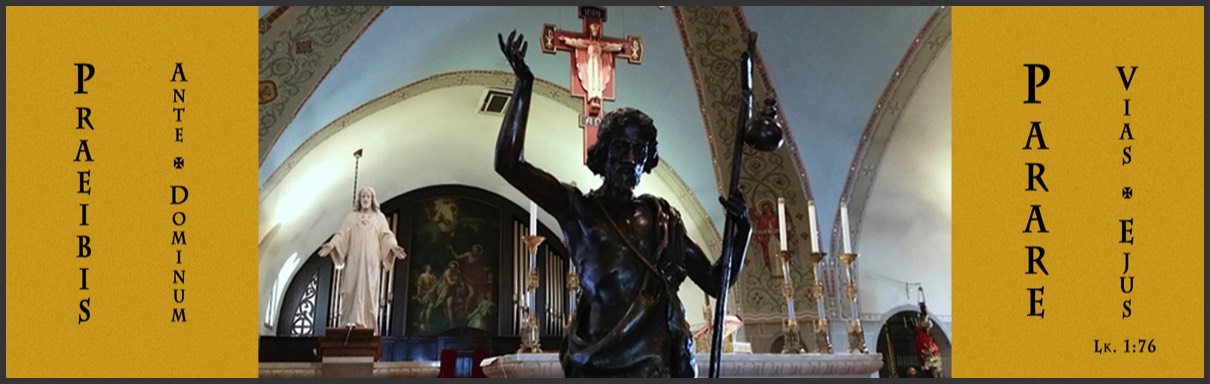
Saint John the Baptist Roman Catholic Parish
1409 Pennsylvania Avenue
Monaca, Pennsylvania 15061